

Agent in the loop (AITL) is how a sub-agent run can pause and get an answer from its parent agent’s model inside the same session. It is the in-tree coordination path: the sub-agent does not call your triggers or the embedded API for help, and it does not talk to your end users the way a root HITL flow does. The parent may answer directly—or escalate so a person answers through a user task when the root run is set up for that. AITL only applies when you use multi-agent systems: a Sub-agent execution mode agent, invoked by a parent that has delegation turned on. If you have not read that page yet, start there for the run tree, step types, safety limits, and how one session wraps parent and child runs.Documentation Index
Fetch the complete documentation index at: https://docs.phrony.com/llms.txt
Use this file to discover all available pages before exploring further.
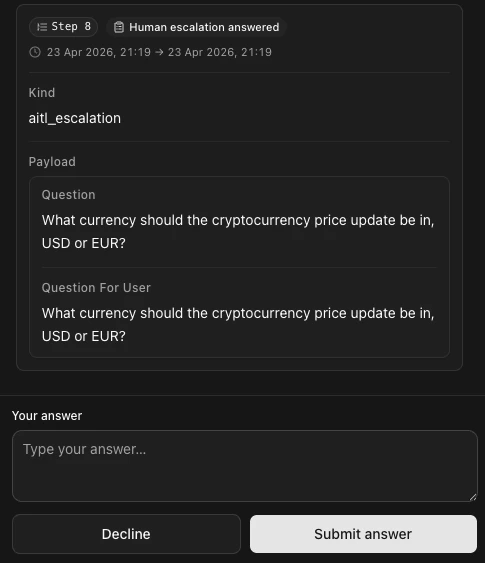
AITL and HITL: different roles
| AITL (this page) | Human in the loop (HITL) | |
|---|---|---|
| Who is in the “loop” | The parent agent (its model) must respond to a sub-agent; optionally a human via the parent. | A person is on the root run path (approvals, forms, and so on). |
| Where it applies | Child runs (sub-agents) asking up; parent runs receiving and resolving those asks. | Root (and the entry trigger you chose for the HITL agent). |
| User tasks | May appear for aitl_escalation when the parent escalates to a human. See User task — kinds. | Approvals, HITL prompts, and other kinds that block the root run directly. |
What each side does
Sub-agent- Receives a task from the parent (via the sub-agent “tool” call). It runs with its own version (model, operations, limits).
- If the task is unclear or it cannot complete work without a decision from above, it must use the ask-parent path built into the platform—not a fake “final” answer that is really a clarifying question in disguise.
- It never routes questions to your customers; it only sees the parent’s answer (or the outcome after escalation) and continues.
- Sees a pending question from a child in the result of the sub-agent call. On the next turn, it should resolve that ask using the AITL actions the product provides (answer from context, or escalate to a person when the tool exists). Skipping that resolution can strand a child and fail the parent run, because the tree is still mid-flight.
- For HITL-mode root parents, expect stricter product rules around when plain user chat is allowed versus an escalation to a user task, so answers get wired back to the right child run. Nested “orchestrator” sub-agents that also delegate are not full HITL sessions; escalation options differ from the root. Details stay aligned with the parent and sub-agent behavior described under Runtime guidance on the Multi-agent systems page.
When a human is involved
Sub-agents do not open HITL dialogues on their own. If a person must answer, the root’s execution mode and the parent’s escalation path create a user task (commonly anaitl_escalation kind). The session can show Waiting for states that make clear an operator must act. After the task completes, the sub-agent run resumes with the result—same as other cross-run coordination in the run tree. Use Review / Approvals the same way as other user tasks.
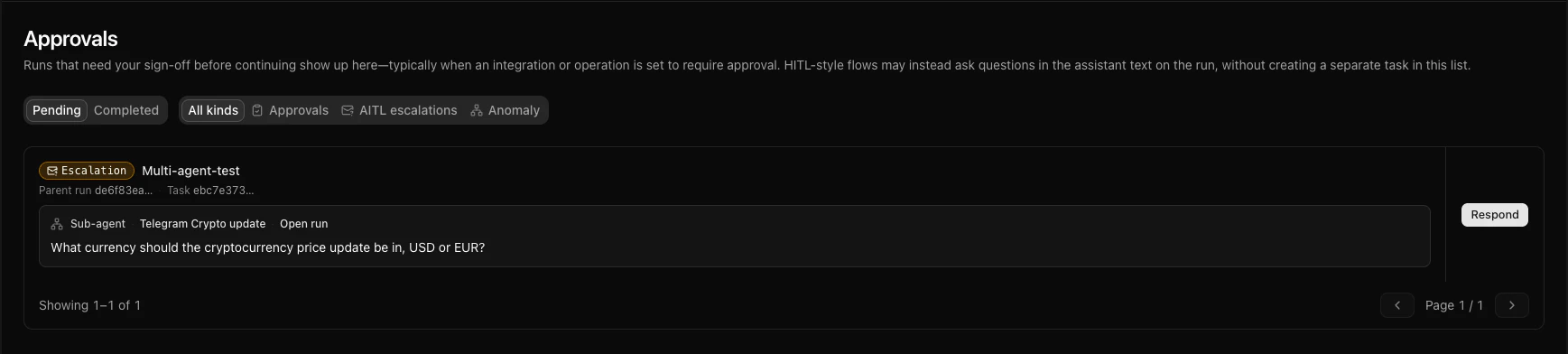
Trace and the dedicated multi-agent guide
The session timeline records sub-agent call, sub-agent result, and AITL-like steps on the parent and child runs. The full list of step concepts, parallel behavior, and safety (cycles, max depth, allowlists) lives on Multi-agent systems so we do not duplicate it here.- Run tree and steps: Run tree, Step types in the trace
- Deeper AITL context in the tree: AITL in multi-agent (same session)
- What Phrony adds to prompts: Runtime guidance (sub-agent and parent “contracts” in behavioral form)
Session completion and debugging
- The root run still defines when the session reaches a terminal success from a product perspective. Child runs finishing alone do not end the story if the parent is still orchestrating or waiting on AITL.
- A child can fail; the parent sees that in the result and decides how to continue. A child failure is not always the same as a whole-session failure.
- If something looks stuck, check Review, the root run’s HITL / escalation state, and the sub-agent run that issued the last ask. For a broader view of observability, see Debugging under When to use Phrony.